
One Family’s Journey, and What a Life-Threatening Allergy Really Demands
The Hoffmann Goldsword Foundation was born from lived experience. It exists to expose a medical crisis that has a systemic blind spot in modern healthcare. What began as one family’s search for answers has become a mission to build transparency, safety, and accountability where none existed before.
By Kenneth Hoffmann, Co-Founder, Hoffmann Goldsword Foundation
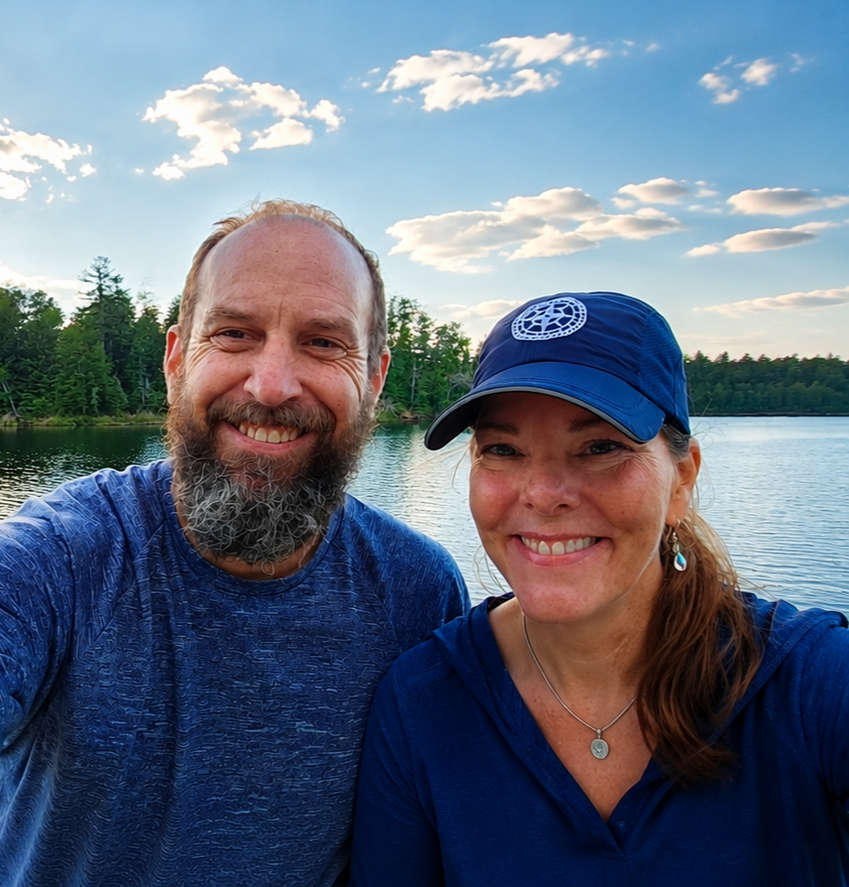
Our Story
My name is Ken Hoffmann, and this is our family's story.
On the morning of October 16, 2024, my wife Katherine and I arrived at the hospital for a four-level cervical spinal fusion. Two days earlier, she had completed a full pre-operative cardiovascular work-up and was medically cleared. But instead of undergoing the planned procedure, Katherine suffered catastrophic medical events before the surgery ever began.
In pre-op, she was given 2% chlorhexidine gluconate (CHG) wipes and instructed to cleanse from head to toe. Less than two hours earlier, she had shaved her body — something we would only learn afterward can sharply increase how much chemical the skin absorbs. When she began wiping her legs, they started burning intensely, to the point that we were pleading for relief. The nursing staff responded with cool, then cold, and then soapy washcloths, but the burning persisted and hives began forming on her legs. We were told it might be simple razor irritation, and the pre-surgical process continued.
As preparations advanced, a Foley catheter was inserted, followed by placement of an arterial line for continuous blood-pressure monitoring. When the team connected the leads, her heart suddenly stopped pumping. She went into pulseless electrical activity (PEA), cardiac arrest, and full anaphylaxis. CPR and advanced cardiac life support were initiated.
Katherine was transferred to the Cardiac ICU, placed in a medically induced coma, and remained on full ventilator support. She sustained fractured ribs and additional spinal injury from resuscitation, and later imaging confirmed a stroke secondary to hypoxic respiratory failure, blood clots, and deep vein thrombosis. She spent two days in the Cardiac ICU and another in recovery before discharge.
At the time, we did not yet have a clear explanation for what had happened, and we began our own search to understand it.
In the months after Katherine was discharged, our lives collapsed into survival mode. She was trying to recover from a cardiac arrest, a stroke, fractured ribs, and additional spinal injury — while still living with the unresolved condition that had brought us to the hospital in the first place. At the same time, we were forced into a role we never anticipated: reconstructing what had happened, identifying the cause, and trying to keep her safe in a system that could not yet name the risk. This work consumed everything. For more than a year, we lived inside medical records, research papers, appointments, and follow-up calls — often fifteen or more hours a day, seven days a week — while her health, her future surgery, and even routine care remained uncertain. What should have been a period of healing became an extended fight for clarity, safety, and basic continuity of care.
In the days after discharge, we carefully reviewed the paperwork and after-visit information we were given. We did not see an allergy acknowledgment or a structured follow-up plan addressing the anaphylaxis itself — what it was attributed to, what exposures to avoid, or how future surgical care would be made safe. That absence mattered, because it meant we were trying to protect her in the real world — at home, in follow-up visits, and in future care settings — without clear guidance on what had nearly killed her.
What we later learned.
As preparations advanced, a Foley catheter was inserted, followed by placement of an arterial line for continuous blood-pressure monitoring. When the team connected the leads, her heart suddenly stopped pumping. She went into pulseless electrical activity (PEA), cardiac arrest, and full anaphylaxis. CPR and advanced cardiac life support were initiated.
Katherine was transferred to the Cardiac ICU, placed in a medically induced coma, and remained on full ventilator support. She sustained fractured ribs and additional spinal injury from resuscitation, and later imaging confirmed a stroke secondary to hypoxic respiratory failure, blood clots, and deep vein thrombosis. She spent two days in the Cardiac ICU and another in recovery before discharge.
At the time, we did not yet have a clear explanation for what had happened, and we began our own search to understand it.
In the months after Katherine was discharged, our lives collapsed into survival mode. She was trying to recover from a cardiac arrest, a stroke, fractured ribs, and additional spinal injury — while still living with the unresolved condition that had brought us to the hospital in the first place. At the same time, we were forced into a role we never anticipated: reconstructing what had happened, identifying the cause, and trying to keep her safe in a system that could not yet name the risk. This work consumed everything. For more than a year, we lived inside medical records, research papers, appointments, and follow-up calls — often fifteen or more hours a day, seven days a week — while her health, her future surgery, and even routine care remained uncertain. What should have been a period of healing became an extended fight for clarity, safety, and basic continuity of care.
In the days after discharge, we carefully reviewed the paperwork and after-visit information we were given. We did not see an allergy acknowledgment or a structured follow-up plan addressing the anaphylaxis itself — what it was attributed to, what exposures to avoid, or how future surgical care would be made safe. That absence mattered, because it meant we were trying to protect her in the real world — at home, in follow-up visits, and in future care settings — without clear guidance on what had nearly killed her.
“Katherine Goldsword is followed in our Asthma, Allergy, and Clinical Immunology clinic for management of perioperative anaphylaxis and mast-cell activation syndrome. Katherine experienced a severe anaphylactic reaction during surgery in October 2024. She has been found to have an allergy to chlorhexidine gluconate. This allergy should be considered severe and life-threatening.
Katherine has been advised to avoid chlorhexidine gluconate in all forms. In particular, this should be avoided in perioperative settings (before, during, and after surgery). Additionally, this needs to be avoided in other healthcare settings including dental cleanings or other dental-related care.
I would strongly encourage that any surgical setting be chlorhexidine-free. Other antiseptics such as povidone-iodine, alcohols, benzalkonium chloride, benzethonium chloride, or parachlorometaxylenol (PCMX) should be used.
Please be aware that this patient is at significant risk for severe anaphylaxis in the event that she is exposed to chlorhexidine.”
— Asthma, Allergy & Clinical Immunology, Children’s Wisconsin / Medical College of Wisconsin
Even now, more than a year later
Katherine has not been able to proceed with her fusion surgery because of ongoing CHG-related safety concerns. The absence of clearly implemented CHG-free alternatives has made providers hesitant to move forward. Those challenges have driven us to act — because if the world does not understand that a truly CHG-free environment is imperative to keep her alive, then we must explain it ourselves.
The Medical Aftermath
In the months following the cardiac arrest, the immediate crisis had passed, but many questions still remained unanswered. Katherine had survived the event, yet her recovery began to reveal symptoms that were difficult to explain.
She developed persistent balance problems and weakness that affected the left side of her body. Everyday tasks that had once been routine became unpredictable. At times she would suddenly lose balance while standing and would fall to the left. Depth-perception problems made even simple movements difficult. On several occasions she reached for objects or attempted to place glasses on shelves, only to knock them over or shatter them because distances no longer appeared where she expected them to be
As physicians continued to investigate what had happened during the perioperative collapse, new findings began to emerge.
Imaging and specialist evaluations eventually identified evidence of a stroke affecting the left cerebellar circulation. Additional evaluations also revealed blood clots that required treatment and careful monitoring.
For months, however, these discoveries unfolded slowly. Each new test or consultation added another piece to the puzzle, but meaningful answers were often delayed. During this period Katherine was navigating both physical recovery and the uncertainty of not yet knowing the full cause of the original reaction. And the underlying spinal condition that had required surgery in the first place had not changed. The medical need for surgical treatment remained — but before any procedure could be reconsidered, physicians first had to understand the reaction that had caused the cardiac arrest and determine how to prevent it from happening again.
Preparing for Surgery Again
By the middle of 2025, we finally had something we had been searching for since the day of the cardiac arrest: a clear answer.
At Children’s Wisconsin, specialized allergy testing confirmed what the pieces of evidence had been pointing toward for months. Katherine had a severe allergy to chlorhexidine — a common antiseptic used throughout modern healthcare and particularly within surgical environments. During the testing process, the reaction to chlorhexidine was immediate and unmistakable, while other medications that had been suspected earlier tested negative. The physicians explained that the results clearly confirmed chlorhexidine as the trigger responsible for the perioperative anaphylaxis.
The confirmation brought a sense of relief, because the mystery surrounding the reaction had finally been resolved. But it also introduced a new challenge. Chlorhexidine is deeply embedded in modern medical practice. It appears in surgical preparation solutions, antiseptic wipes, catheter kits, dressings, lubricants, and many other routine products used across hospitals. Avoiding it completely requires careful coordination between surgeons, anesthesiologists, nurses, and pharmacy teams. Every product used in an operating room must be reviewed in advance to ensure it is free of chlorhexidine, and alternative preparations must be planned ahead of time.
Despite those challenges, the diagnosis also gave us something we had not had before: a path forward. Physicians also explained that confirmed chlorhexidine anaphylaxis is considered rare, with relatively few well-documented cases in the medical literature — so few that many surgical teams may never knowingly encounter it in a career. (That rarity is exactly what our investigation set out to examine: whether these reactions are truly rare, or simply rarely recognized and recorded. What we found is on the Investigation page.)
The Uncertainty of Moving Forward
As discussions about surgery resumed, the central question facing the medical team was no longer simply when the procedure could be scheduled, but whether it could be performed safely at all.
During a neurosurgical consultation in April 2025, Katherine’s imaging was reviewed and physicians confirmed that the cervical compression that had originally required surgery was still present. Surgically addressing the condition remained a reasonable option. But the conversation quickly turned to the same concern that had now followed us through every appointment since October: the risk created by the chlorhexidine reaction.
The surgical team explained that several questions first needed to be resolved before any operation could be planned. The allergy evaluation needed to pin down the precise trigger.
The Day Before Surgery
The anticoagulation treatment required for the newly discovered blood clots had to be carefully managed. And the anesthesia team would need to determine whether a surgical plan could be designed that completely avoided substances capable of triggering another reaction. In the surgeon’s words, the first step was determining whether surgery could safely proceed at all.
That uncertainty changed the entire trajectory of the process. Instead of preparing directly for an operation, the months that followed were spent working through consultations, testing, and planning to determine whether the healthcare system could safely perform the surgery Katherine still needed.
By early 2026, after months of consultations, testing, and planning, the path back to surgery finally appeared clear. The surgical team had reviewed Katherine’s medical history, imaging, and allergy documentation. Pre-operative appointments were completed, and the procedure was scheduled. For the first time since October 2024, it felt as though the long search for answers had finally brought us back to the operating room.
But even as the surgery approached, the chlorhexidine allergy remained part of every discussion. Less than twenty-four hours before the scheduled procedure, the plan changed.
After a final review of the risks associated with Katherine’s confirmed chlorhexidine allergy — and the complexities involved in eliminating exposure within the surgical environment — the medical team determined that the safest course of action was not to proceed with the operation at that facility. The decision was not about whether the surgery was necessary; that need had already been established and remained unchanged. The concern was ensuring the surgery could be performed in an environment fully prepared to manage the unique risks of her allergy. Out of caution, the surgical team recommended that her care be referred to a higher-level center capable of coordinating a completely chlorhexidine-free surgical pathway.
Where Things Stand Now
As of spring 2026, the long search for a surgical team able to safely perform Katherine’s procedure has finally reached a turning point.
Following the cancellation of the February surgery, referrals were sent to identify medical centers with the experience and resources necessary to coordinate a completely chlorhexidine-free surgical environment. The medical need has never changed — the cervical compression that originally required surgery in 2024 still remains. What has changed is the complexity of safely performing it.
For patients without this allergy, the procedure Katherine requires is a routine part of modern spine care. For patients with a severe chlorhexidine allergy, the challenge isn’t the surgery itself — it’s navigating a healthcare system where one of the most widely used antiseptics in medicine is also a potentially life-threatening trigger. That reality has meant delays, uncertainty, and a much smaller number of providers able to safely take on the case. The search narrowed to two large, university-level centers better equipped to plan around her allergy.
The first of them declined, judging a chlorhexidine-free spinal fusion too risky to undertake as an “elective” procedure. To us there was nothing optional about it — Katherine’s worsening neurologic symptoms and the unresolved cervical compression made the surgery medically necessary — but framed as elective, it was a risk that center was unwilling to assume.
Then, on April 1, 2026, Mayo Clinic accepted Katherine as a high-risk patient.
“Only zebras get to come to Mayo Clinic. You are a zebra. You have a letter to prove it.”
— the Mayo Clinic doctor who accepted Katherine’s case
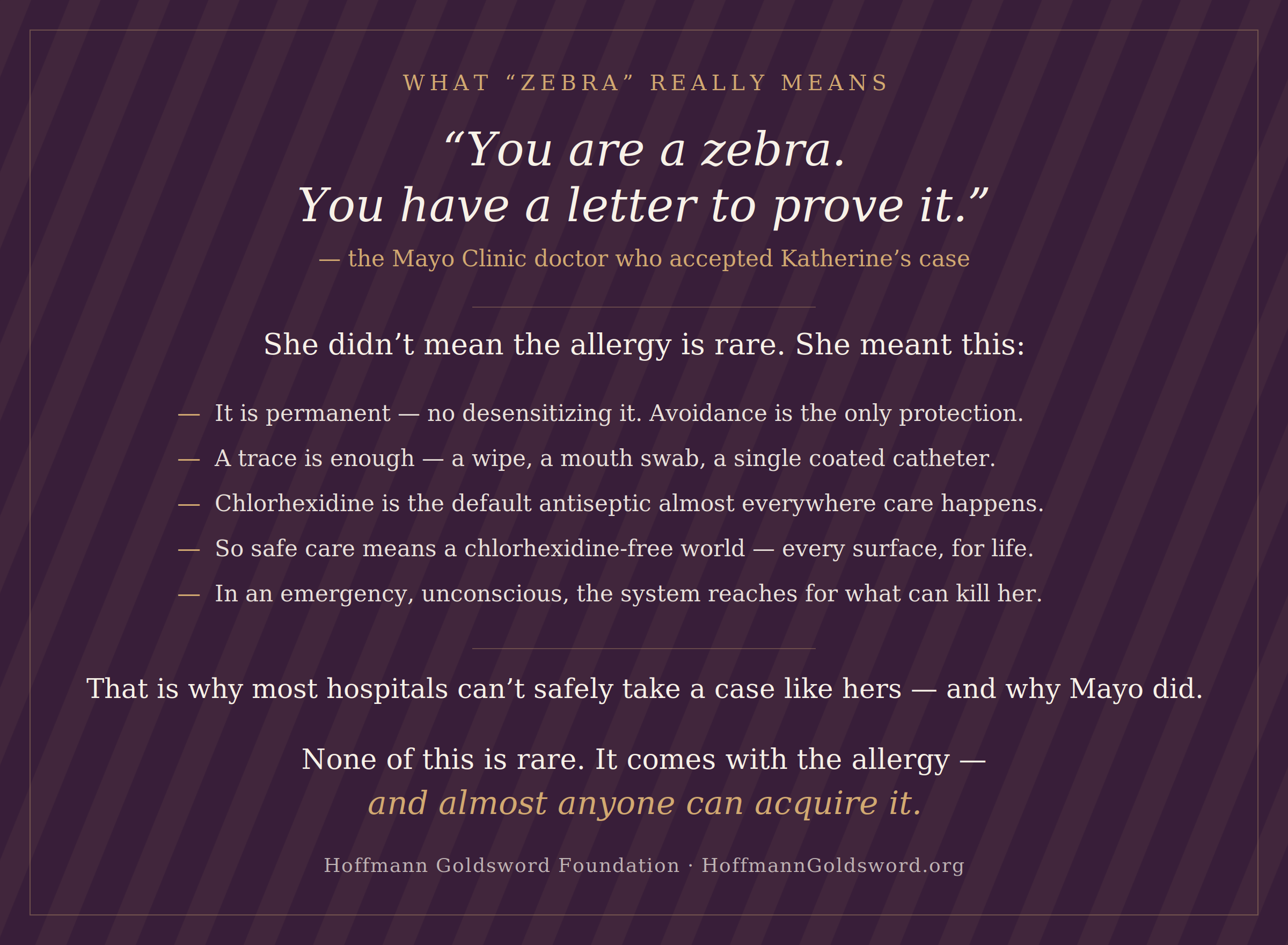
There is an old teaching adage in medicine — when you hear hoofbeats, think horses, not zebras — a reminder to reach first for the common explanation. When a Mayo Clinic doctor told us Katherine was a zebra, she did not mean her allergy was a medical rarity. She meant what we had been living for more than a year: that safely caring for someone with a life-threatening chlorhexidine allergy is extraordinarily complex. The allergy is permanent — there is no desensitizing it, no protocol to teach the body to tolerate it again; avoidance is the only protection. She can react to trace amounts, through skin, mucous membrane, or the bloodstream. And chlorhexidine is the default antiseptic across modern care — surgical prep, central lines, daily ICU bathing, dental irrigation and rinses — so keeping her safe means a completely chlorhexidine-free environment: every product, every surface, coordinated across surgery, anesthesia, nursing, and pharmacy, in every setting, for the rest of her life. The hardest part is the emergency no one can plan for: if she ever arrives unconscious and unable to speak, the standard protocols reach automatically for the very substance that can kill her, and there is no one to intercept. That is what makes her a “zebra” — not a rare allergy, but the extraordinary, lifelong complexity of treating one safely. And none of it is unique to Katherine. It comes with the allergy — an allergy almost anyone can acquire. What we came to understand is this: the biology is dangerous, but it is manageable through avoidance. It is the system — defaulting to chlorhexidine, hiding it behind vague labels, and removing the chance to intercept — that makes that avoidance so hard. That is also why most hospitals couldn’t safely take her on — and why Mayo could. Mayo accepted her case precisely because it recognized what managing a life-threatening chlorhexidine allergy actually requires, and that it is one of the few centers equipped to coordinate and hold a completely chlorhexidine-free pathway across every department, when most simply are not. For the first time since October 2024, Katherine’s case had found a center willing to take it on with her allergy fully accounted for. We are continuing to work toward getting her the surgery she needs, in a safe, chlorhexidine-free environment.
Our experience also revealed something broader about patient safety. Even when a life-threatening allergy is documented in the record, protecting a patient requires that healthcare teams recognize the risk early enough to change the workflow around a procedure. When a substance is woven into routine hospital practice, avoiding it safely takes deliberate planning across many departments before care can move forward.
The clinical findings from Katherine’s case were formally reviewed by Children’s Wisconsin. Their evaluation did more than validate one patient’s diagnosis — it contributed to broader chlorhexidine-awareness efforts within perioperative safety education.
In November 2025, clinicians from Children’s Wisconsin presented findings drawn from Katherine’s documented case — shared without identifiers — at the American College of Allergy, Asthma & Immunology (ACAAI) Annual Scientific Meeting. The presentation highlighted the risks of chlorhexidine absorption through shaved or waxed skin and its implications for perioperative safety nationwide.
While the Hoffmann Goldsword Foundation is not affiliated with this research, its appearance on a national clinical stage marked a turning point: what began as a nearly fatal event was now informing evidence-based education and prevention across the field.
A Case That Reached a National Stage
The Unseen Epidemic: When Safety Systems Can’t See
In the weeks after Katherine’s cardiac arrest, we kept asking the question every family would: how could something this severe happen before a routine surgery even began — and how could no one have seen it coming?
As we sifted through records, discharge notes, and the medical literature, the same chemical appeared again and again: chlorhexidine gluconate. It is the most widely used antiseptic in modern healthcare — considered standard, safe, almost invisible. Yet the literature and international safety bulletins have linked it to severe allergic reactions and anaphylaxis for years. The warnings existed. The awareness did not keep pace.
Chlorhexidine hides in plain sight: in wipes, catheter gels, IV dressings, dental products, hand rubs, even everyday personal-care items. Labels often use vague language like “antiseptic” or “medical-grade cleanser,” and the ingredient may never be clearly disclosed at all.
And there is a second blind spot beneath the first: the system itself is not built to see these reactions. Chlorhexidine reactions are often miscoded as anesthesia reactions or unspecified anaphylaxis. Once misclassified, they vanish from the safety data — and the risk is carried forward, unseen, to the next patient. What happened with latex decades ago is repeating with chlorhexidine; but this time, the blindfold is built into the data structures themselves.
What happened with latex decades ago is repeating with chlorhexidine — but this time, the blindfold is built into the data itself.
From Awareness to Action
Over months of research and consultation, a clearer picture emerged:
• Chlorhexidine reactions are real, severe, and under-recognized.
• Damaged skin dramatically increases absorption.
• Sensitized individuals can react to trace exposures.
• Few hospitals have reliable chlorhexidine-free protocols.
Throughout this, Katherine was also trying to recover and function day to day while her future care remained uncertain. The toll did not end at discharge — it followed her into every appointment, every decision, every delay.
That is what led us to create the Hoffmann Goldsword Foundation: not to assign blame, but to make invisible risks visible, and to build systems that finally see.
This is our story. The full investigation — the evidence, the numbers, and how a danger this real stays this invisible — is laid out in depth here:
By Kenneth Hoffmann and Katherine Hoffmann Goldsword, Founders · Hoffmann Goldsword Foundation. Published under CC BY-NC-SA 4.0 —https://creativecommons.org/licenses/by-nc-sa/4.0/ © 2025–2026 Hoffmann Goldsword LLC · HoffmannGoldsword.org

Get Involved
The Foundation runs on people who recognize the gap and want to help close it. Donate, share your story, partner with us, or simply spread the word.
The Hidden Risk
What chlorhexidine is, where it appears, and why a severe allergy to it is so difficult for healthcare systems to recognize, track, and respond to.
Research & Evidence
The clinical literature underlying this work — including peer-reviewed studies, conference presentations, and documented case findings.